Signaling failure causes deadly high-speed train collision near Madrid
A computer glitch triggered a crash that killed 68 people just weeks before Spain's national elections, prompting a national day of mourning.
By Aminata Patterson ·
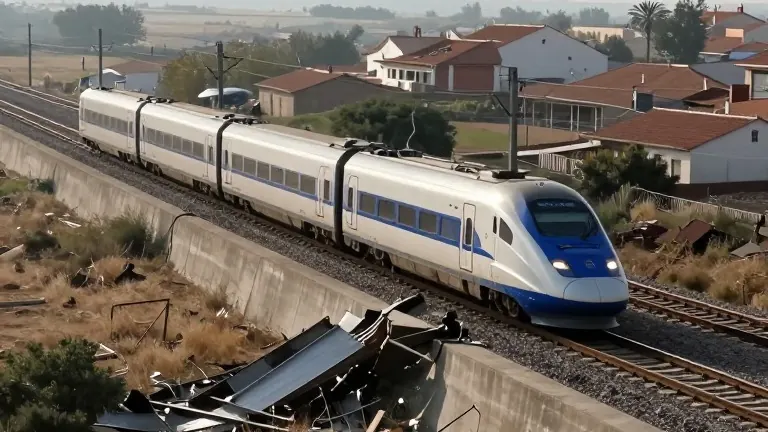
A high-speed train crashed into the rear of a stationary service near Urda, Spain, on Wednesday morning, killing at least 68 people. The impact occurred shortly before 9:00 a.m. local time, striking a section of track south of Madrid. Regional officials confirmed that approximately 80 additional passengers sustained injuries in the collision.
The accident involved two trains traveling from Madrid to Seville. A Renfe service, operated by Spain's state-owned rail company, carried 397 passengers. The Iryo train, run by a private competitor that entered the market in 2022, held 147 passengers. Two carriages from the Iryo train derailed and fell down an embankment. Emergency teams recovered 52 bodies from the wreckage and are searching for victims trapped under the debris.
Regional president Emiliano Garcia-Page stated that 50 of the injured are in serious condition, with 15 of those patients classified as critical. Severely hurt survivors were transported to hospitals in Madrid and the surrounding region. Others were triaged at a nearby sports hall. Juan Quesada, a 65-year-old survivor who suffered a head injury, described the moment of impact as producing a tremendous noise.
Transport Minister Oscar Puente attributed the crash to a computer failure that disabled the LZB signaling system at 8:30 a.m. This system normally keeps trains at safe distances. The failure caused six trains on a 63-kilometer stretch to stop automatically. Control shifted to a center in Madrid managed by Adif, the state infrastructure manager. Controllers cleared the Renfe train to resume normal speed at 8:36 a.m. The Iryo train received the same order at 8:41 a.m. but remained stalled. Its driver reported the stoppage at 8:48 a.m.
By that time, the Renfe train was traveling at speeds exceeding 200 kilometers per hour. It struck the Iryo service at 8:53 a.m. Puente called the control center's order inexplicable and stated that the drivers and engineers were not at fault. Standard Spanish rules limit speed to 40 kilometers per hour after an LZB failure. A backup system exists but only detects signals at specific points. Reports indicate no trackside signal existed between the two trains that could have stopped the Renfe service.
Adif has suspended high-speed services between Madrid and Andalusia. Renfe halted ticket sales for this corridor until December 13, with an alternative service beginning Friday. This is the deadliest rail accident in Europe since a 2013 derailment in Santiago de Compostela that killed 80 people. Another high-speed crash near Adamuz in January killed 46 people. Prime Minister Pedro Sanchez visited the site and declared three days of national mourning starting Thursday.
Sanchez said the causes of the two crashes appear unrelated but called two such accidents in one year unacceptable. The Madrid-Seville line is the only high-speed route still using the 1992-era LZB system. Adif began work in 2021 to replace it with the EU standard system over a 52-month contract. The project is still under way. Opposition People's Party leader Alberto Nunez Feijoo canceled events during the mourning period. He said the moment is to respect the dead, the injured, and their families.
The disaster has become a political issue ahead of national elections. Approximately 1,500 people, gathered by right-wing youth groups, protested outside the Ministry of Transport on Wednesday evening. They demanded Puente's resignation and clashed with police. Sanchez canceled upcoming campaign rallies. Vox leader Santiago Abascal continued campaigning, calling the government a criminal organization and vowing to take it to court.
Source: Al Jazeera