Drone photo of shipwreck in Bangladesh wins top prize
George Steinmetz captured a dismantled LNG tanker at low tide for the 2026 Siena Drone Photo Awards.
By Rosa Kovalenko ·
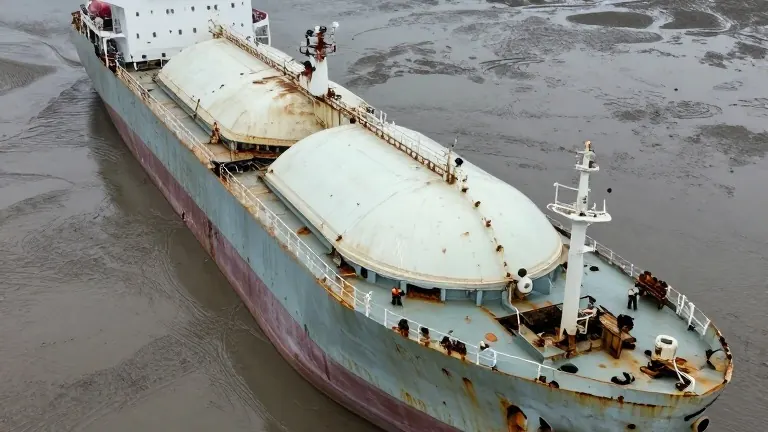
George Steinmetz won the top prize at the 2026 Siena Drone Photo Awards with an aerial image of a liquid natural gas tanker stranded on the mudflats of the Bay of Bengal. The photograph, titled 'Shipbreaking on the mudflats, Bay of Bengal,' depicts the vessel’s steel hull partially dismantled while workers mill around it. The image offers a stark view of the shipbreaking industry north of Chattogram, Bangladesh.
Steinmetz told NPR that he has long been fascinated by the region’s shipbreaking sector. Vessels from around the globe end their working lives there, where their materials are recovered for reuse. He viewed the industry as an example of recycling on a vast scale while exploring the relationship between human populations and the environment for a book project.
Accessing the site proved difficult because shipyard owners are often wary of journalists. Local photographers warned Steinmetz that securing access might be nearly impossible. He surveyed the 13-mile coastal strip with his drone to find a vessel in a striking state of disassembly. He eventually convinced the tanker’s owner to allow him to photograph the ship.
The timing of the shot was critical. Steinmetz waited for low tide to expose the surrounding mudflats. This allowed the tiny figures of the workers to appear like ants against the enormous hull, providing a clear sense of the ship’s scale. He spent several days returning to the site as tides shifted and workers used winches and boats to pull scrap metal ashore.
Steinmetz graduated from Stanford with a degree in geophysics in 1979. He first dreamed of photographing landscapes from above while hitchhiking across Africa on the roofs of trucks. In 1996, National Geographic financed an aerial photography project around the Sahara, for which he learned to fly a motorized paraglider. He described the experience as sitting on the front of a spoon.
Drones have since transformed aerial photography for Steinmetz. The technology allows photographers to capture perspectives that were once difficult or expensive to achieve. He continues to use the drone to reveal stories that remain invisible from the ground.
Other winners in the contest focused on the Global South. Dilek Yurdakul won first place in the People section with a photo of carpet fields in southern Türkiye. Yurdakul traveled six hours from Ankara to the Döşemealtı district of Antalya to capture the traditional process of fading handmade rugs in the sun. She stated that the aerial perspective served as a visual metaphor for the invisibility of labor.
In the Nature category, Colas Decloitre received a high commendation for a shot of Tumpak Sewu waterfall in East Java, Indonesia. The image shows the horseshoe-shaped waterfall at sunrise with Mount Semeru erupting behind it. Decloitre noted that the drone was the only way to align the waterfall and the volcano in a single frame.
Isabella Tabacchi earned a commendation for 'The Last Ember,' a photo of a volcanic cone in the Argentine Puna. Tabacchi captured the image during an exploratory flight while studying the landscape. She found the geometry of the lava field and the red cone more powerful than traditional golden hour lighting. Holly Kirkland also received a commendation for 'What Lies Beneath,' which shows lesser flamingos over Lake Natron near the Tanzania-Kenya border.
Kirkland took that specific photograph in a helicopter rather than with a drone. She used a Sony A1 Mark II camera with a 70-200mm f/2.8 lens while hovering over the soda lake. The image highlights the ecosystem of the Rift Valley, where flamingos have evolved leathery skin and specialized salt glands to survive the caustic waters.
Source: WUSF Public Media