Fear drives Palestinian citizens of Israel toward the polls as their votes could decide Netanyahu's fate
With polls showing neither Netanyahu's coalition nor the opposition bloc reaching a majority, Palestinian citizens of Israel could hold the balance in next week's election.
By News Media House Staff ·
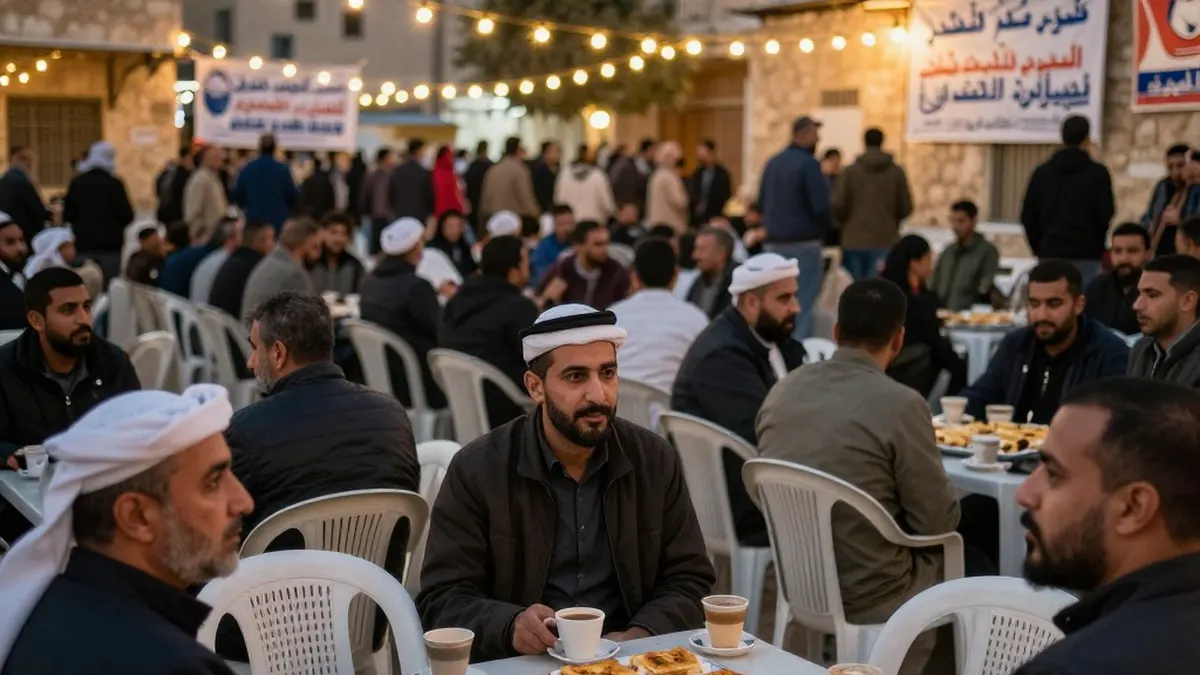
In the town of Kfar Qasim, Palestinian citizens of Israel gathered over knafeh pastries and cardamom coffee at sunset to hear candidates ask for their votes. The turnout of this community, which makes up about 20% of Israel's population, may prove decisive in next week's elections.
Most polls suggest that Benjamin Netanyahu's far-right coalition will lose its majority in the 120-seat Knesset. The Jewish Israeli opposition bloc, however, is also forecast to fall short of the 61 seats needed to govern. Palestinian citizens of Israel are projected to win between 12 and 15 seats, split between the Islamist Ra'am party and the Joint List, an alliance of three smaller parties that includes Ta'al.
"We are determined to do everything in order to bring this government down. And high turnout among the Arab community is one important tool in achieving this goal," said Ahmad Tibi, who heads Ta'al and has sat in the Knesset for more than two decades.
Most of the Jewish Israeli opposition has ruled out a coalition with Arab politicians, and Netanyahu and his allies have worked to make any such alliance politically toxic. Campaign posters have declared "It's [either] the right or Palestine," while others on the right use the slogan "Bibi or Tibi," although Tibi is unlikely to receive even a junior ministerial post. Israel has had only two Palestinian ministers in its history: Raleb Majadele, who held the sport portfolio for two years, and Issawi Frej, who handled regional coordination for just over a year.
Promises to avoid Palestinian parties have been broken before. In 2021, Ra'am leader Mansour Abbas took his party into a historic coalition with Naftali Bennett, who is now in the opposition bloc, and Netanyahu himself once opened coalition talks with Abbas. Mohammed, a prospective voter who manages Jewish and Arab staff at a hi-tech company, expects the opposition to change its position once results arrive. "At the end of the day, everything is mathematics, right? One plus one is two," he said, adding that he is urging friends of all backgrounds to vote.
An alliance would be difficult for Palestinian politicians too. None of the opposition parties call for a two-state solution, most strongly oppose a Palestinian state, and most back the settlement movement in the occupied West Bank. "It's between bad and worse," Tibi said, describing his choice as one between Netanyahu, Bezalel Smotrich and Itamar Ben-Gvir on one side and the opposition on the other.
Fear is a central motive. The death and destruction in Gaza, militant violence and ethnic cleansing in the West Bank, and rising racism and discrimination inside Israel have deepened worries about another four years of far-right ministers. "The biggest motivation is fear," said Sami Abu Shehadeh, leader of the Balad party. He said voters understand the danger if "these criminals come back to rule again."
Turnout has been depressed in the past by distrust of a system seen as stacked against Palestinians. Last month Israel's supreme court effectively forced Abu Shehadeh out of the race over an article about the 7 October Hamas-led attacks, a ruling widely criticised for applying different free speech standards to Jewish and Palestinian citizens. A motion to disqualify national security minister Itamar Ben Gvir over racist language, including calls for ethnic cleansing, was not upheld. Some Palestinians abstain on principle, among them Haaretz journalist Nagham Zbeedat, who wrote that she refuses to "legitimize a system that treats my rights as favors."
Amjed Iraqi of the International Crisis Group said a returning far-right coalition would have a renewed mandate to speed up policies of ethnic cleansing and annexation. He described the vote as largely about mitigation, noting that Palestinians can see the difference between a rightwing and a far-right government. The election also falls two days before Kafr Qassim marks the 1956 massacre in which border police killed 49 men, women and children who had broken a curfew they did not know about. "There's no clarity about what comes afterwards," Iraqi said, "but that's how powerless I think a lot of people feel."
Source: The Guardian