Fossil Fuel Emissions May Have Halted the Start of a New Ice Age, Study of Arctic Ice Cap Suggests
Research on Canada's Barnes Ice Cap indicates it had been expanding for about 2,000 years before reversing course in the 1960s as carbon pollution climbed.
By News Media House Staff ·
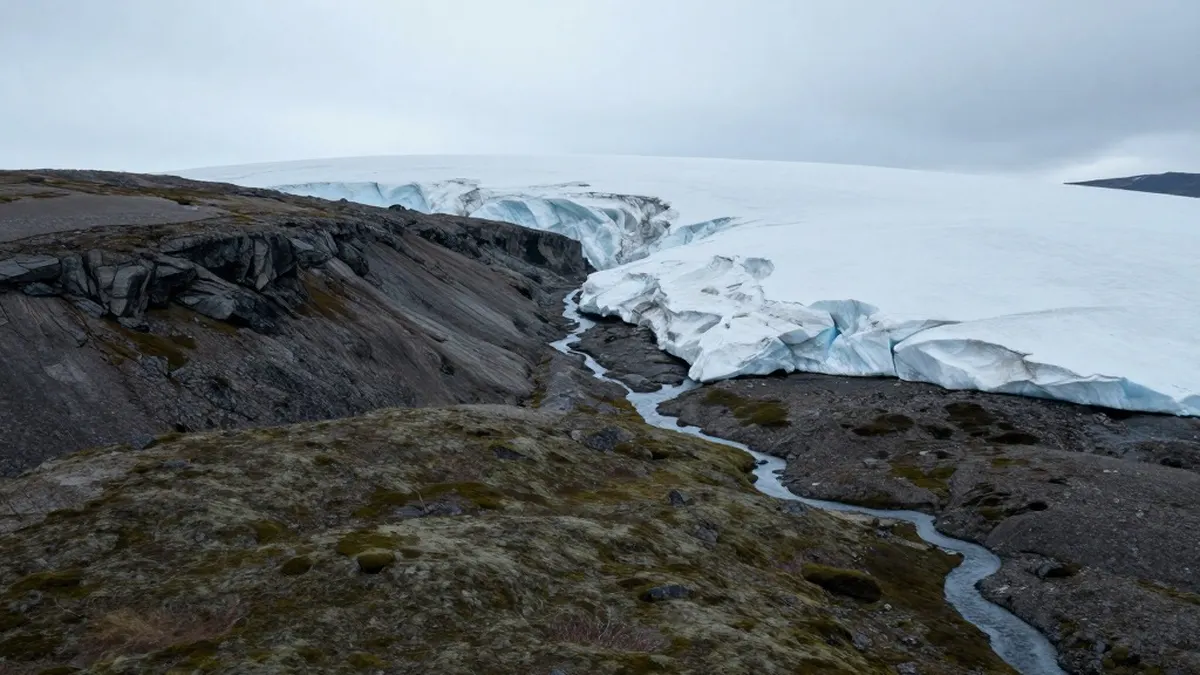
Burning fossil fuels may have stopped the Earth from sliding into another ice age, according to a new study published Thursday in the journal Science. The work draws on ancient vegetation and rock records to trace the growth and sudden shrinkage of the Barnes Ice Cap, the last remnant of an ice sheet that once blanketed much of North America.
The Barnes Ice Cap sits on Canada's Baffin Island. The researchers found that it began growing a few thousand years ago, then sharply reversed direction starting in the 1960s, as carbon pollution increased.
The planet periodically passes through phases in which ice spreads from high latitudes, commonly called ice ages. These are driven by natural shifts in Earth's rotation and orbit known as Milankovitch Cycles, and are followed by interglacial periods in which ice pulls back toward the poles. The most recent ice age ended 12,000 years ago. At its height, the Laurentide Ice Sheet covered all of Canada and reached as far south as New York and the Midwest. The Barnes Ice Cap, which is about the size of Delaware, is what remains of it.
Unlike many glaciers, the ice cap does not move: it is frozen to the bedrock. That means plant material that grew near it has been preserved beneath the ice, giving scientists a record of its expansions and contractions.
To establish when the ice cap first reached its current size, the team used exposure dating. By measuring Beryllium-10, an element that forms on exposed rock surfaces, they estimated how long rocks several meters from the ice edge had been uncovered. Their calculations put the ice cap at its present size about 3,600 years ago.
They then turned to mosses and lichen on the tundra in front of the ice to see how far it had regrown. "After the ice cap retreated, mosses eventually colonized this newly exposed land," said Nicolás Young, a paleoclimatologist at Columbia University's Lamont-Doherty Earth Observatory and the study's lead author. When the ice re-expanded, it covered and killed the moss. Remains of that dead moss, now exposed again, allowed the team to build a timeline of the ice's advance. They estimate the ice cap began growing again roughly 2,000 years ago, possibly the start of a new glaciation.
Beginning in the 1960s, however, the ice cap started shrinking, which would not be expected during an ice age. Historic aerial photographs show significant retreat from its new margins, and its edges have receded by an average of 4 meters per year since the 1980s. That coincides with a surge in carbon emissions that has driven ice loss worldwide. "Modern retreat of this glacier has reversed 2,000 years of net expansion, that's a pretty decent chunk of time," Young said.
Andrew Wickert, an associate professor of environmental science at the University of Minnesota Twin Cities who was not involved in the research, said the public has wondered whether warming has been enough to prevent the next ice age. The findings show that "even as we were just starting to ramp up emissions, we've already done enough damage to cause the major North American ice sheet to already start retreating. That's significant," he said.
Meredith Kelly, a professor of earth sciences at Dartmouth, called the data "awesome" and said it shows a "clear pattern of what the ice cap was doing." She would like to see some of it compared with other sites around the world to better understand how the Earth was entering a glaciation before human-caused warming took hold. The exact mechanisms that trigger ice growth, she noted, still need more research.
Young said the findings could also bear on a decades-old claim often cited by climate deniers. In the early 1970s, scientists meeting at Brown University concluded that a glaciation was imminent and wrote a warning letter to President Richard Nixon. Young said two of his coauthors attended that meeting. Coverage of it, along with a cooler spell in the 1970s, has been used to argue global warming is not happening. "I think this study actually helps show that scientists were right about a pending glaciation," Young said, while the new research adds to evidence that warming is real.
Source: Wired